
A well-designed name tag does more than identify a person. It supports branding, improves trust, and makes everyday interactions easier. For many businesses, the difference between a generic tag and a thoughtful one comes down to a few strategic choices: material, readability, fastening, and finish. That is why designing a custom name tag deserves more attention than it often gets.
When done well, the result feels effortless to the customer and practical for the team. When done poorly, the tag becomes hard to read, uncomfortable to wear, or out of sync with the company’s image. Name At A Glance understands that a name tag is a small object with a large job, and the design choices behind it should reflect that.
Start With the Role the Name Tag Needs to Play
The first mistake businesses make is treating every name tag as interchangeable. A tag for a retail associate, a healthcare worker, a trade-show representative, and a corporate front-desk employee may all serve the same basic function, but the design priorities are not the same.
These tags can be variable according to the designation or department. In every business or corporation, there are many departments, and these tags can make it visually easy to know for whom to see who is responsible for certain tasks as workplace harassment issues. For these kind of issues, it should be easy to find a right person to aproach without hestation and tags can help to understand the postition and role of that person in the company.
A strong brief starts with the purpose of the tag. Ask what it needs to do in practice, not just what it should look like on paper. That usually means defining whether the tag is meant to prioritize brand visibility, employee readability, durability, or a more polished presentation.
In many cases, the right custom name tag is not the most elaborate one. It is the one that solves the actual use case cleanly.
Match the Tag to the Environment
The work environment should influence every major decision. A tag worn daily in a busy setting needs a different construction than one used occasionally for events or executive meetings.
Consider these practical questions:
- Will the tag be worn all day or only for short periods?
- Will it be exposed to friction, cleaning, or moisture?
- Does the uniform allow pins, clips, or magnets?
- Should the design feel understated or visually prominent?
- Will the tag need to be reused across multiple employees or kept personal?
These questions matter because the best choice on a mockup can fail in real life. Name At A Glance offers enough flexibility in materials and fastening options to support different work environments without forcing a one-style-fits-all approach.
Design for Fast Recognition, Not Just Visual Appeal
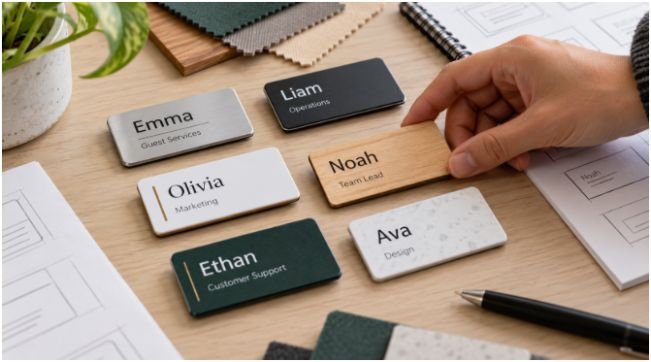
A name tag should be readable in a second or less. That sounds simple, but it is where many designs break down. Decorative fonts, crowded layouts, weak contrast, and unnecessary embellishment can make the tag look attractive while reducing its real value.
A business tag should answer three questions immediately: who is this, what organization are they with, and is the text easy to trust at a glance? If any of those answers is unclear, the design is not doing its job.
This is where line structure becomes important. Many businesses do well with one, two, or three lines of text, depending on the amount of information they need to show. The most important line should be visually dominant, not buried in the layout.
Typography and Layout Should Work at Conversation Distance
Most name tags are read during real-world interaction, not from across a room. That means the font choice, letter spacing, and hierarchy should work at close conversational distance.
A few practical rules help:
- Use simple, highly legible typefaces.
- Keep employee names prominent.
- Avoid placing too many elements in one line.
- Use contrast that holds up under indoor lighting and movement.
- Leave enough white space so the tag does not feel crowded.
If a logo is part of the design, it should support the layout rather than compete with it. Hybrid styles can be useful here, especially when a company wants a printed logo paired with engraved employee information. Name At A Glance has the customization range to make that balance workable without sacrificing clarity.
Choose Materials and Finishes That Reflect the Brand Honestly
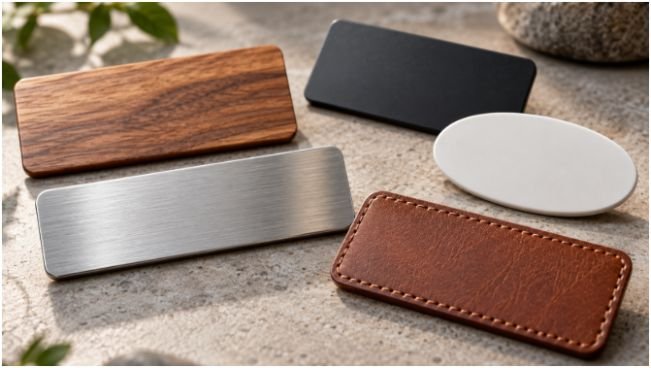
Material choice is where a business often makes its strongest visual statement. Plastic is practical and familiar, but it is not the only option. Businesses looking for a more distinctive presentation can explore solid woods, birch, leather, brushed metal, framed styles, pocket styles, rhinestone accents, and domed finishes.
The key is not to choose the most premium-looking material automatically. It is to choose the one that aligns with the brand’s tone and the reality of how the tag will be used. A polished-looking tag speaks to the brand identity and tone and is a good way to attract new customers for your business by representing your business as premium and elite.
A polished metal look may suit a professional services firm. A warm wood finish may feel more natural for hospitality or artisan brands. A domed name tag can add dimension and a clean finished appearance. For many businesses, the decision is less about novelty and more about whether the material reinforces the company’s identity.
Printing and Engraving Serve Different Needs
The personalization method matters just as much as the base material. Rotary engraving and laser engraving offer a durable, scratch-resistant finish that holds up well over time. Full-color printing can better support logos, color branding, and more visually expressive designs. UV ink and heat transfer printing can also help create crisp, vivid presentations.
In some cases, a hybrid approach is the smartest move. A printed logo can carry the brand color, while engraved text keeps employee names highly legible and durable. That balance is often more effective than trying to force every detail into a single method.
Name At A Glance supports these choices with a practical product range, which is especially valuable when a business wants consistency across departments but not necessarily identical designs for every use case.
Fasteners, Shape, and Edge Details Affect Daily Wearability
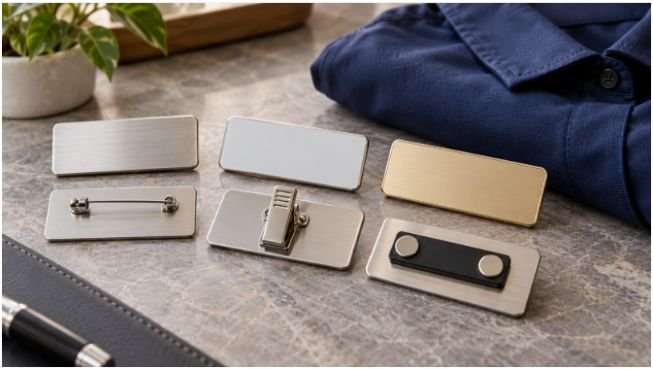
People often focus on graphics first and forget the details that determine whether the tag is comfortable to wear. Fasteners, edge style, and shape all affect how the tag performs during a long workday.
Pins are familiar and inexpensive, but they puncture clothing. Clips can be helpful when fabric protection matters. Magnet bars are popular for a cleaner wear experience, while heavy-duty magnet bars are better suited for more secure attachment on certain garments. Tape can work for specific applications, though it is not ideal for every use.
The best option depends on the uniform, the fabric, and the amount of movement expected during the day. A fastener that looks convenient in theory may become a frustration in practice.
Shape and Edge Choices Change the Final Impression
Shape is another design choice that affects both style and function. Standard rectangles and ovals are common because they are straightforward and readable. But many businesses benefit from pre-set industry cutouts or even fully custom shapes.
Edge finishing also matters more than most people expect. Beveled edges can make a tag feel more refined. Rounded corners may soften the overall look and improve comfort. Raw cuts can suit certain practical applications. These are not minor details; they shape the impression the tag gives before anyone reads the text.
For businesses ordering through Name At A Glance, this level of flexibility makes it possible to tailor a name tag to the environment instead of settling for a generic option.
Think in Terms of Volume, Consistency, and Total Value
A custom order should be judged on more than the unit price. The real value comes from how well the tags hold their appearance, how consistently they represent the brand, and how efficiently they can be ordered at scale.
That is especially important for businesses outfitting multiple employees or multiple departments. A design that works for one person may still need to be standardized across a team. In that case, the business should think about both one-product use and combined-product use: a single tag for an individual employee, and a broader system for a full group or mixed department order.
Name At A Glance offers quantity discounts that can materially improve the economics of larger orders, though specialty exclusions may apply on certain items. That makes planning important. A business that knows its likely headcount, department mix, and replacement needs can usually make better decisions up front.
Here is the practical way to think about value:
- Choose a design that can be reordered consistently.
- Use materials and finishes that fit the expected lifespan.
- Confirm that the fastening method is appropriate for the uniform.
- Consider whether the same design can work across multiple roles.
- Review how branding, readability, and durability trade off against one another.
A lower-cost tag that wears out quickly or creates a poor impression is not really cheaper. In many cases, a sturdier design is the more efficient long-term choice.
A Strong Design Process Makes the Result Look Effortless
The best business name tags usually come from a disciplined process, not a rushed decision. Start with the environment, then define the message, then choose the material and fastening method that support both. That sequence prevents the common mistake of designing for appearance alone.
It also helps to work with a supplier that can handle practical detail well. Name At A Glance is built for that kind of job: broad material options, multiple finishing methods, shape flexibility, production tracking from start to finish, and the ability to balance branding with wearability. For businesses that want a custom name tag to do more than identify an employee, that combination matters.
If you are designing tags for your team, think beyond the graphic mockup. Ask how the tag will feel after a full shift, how clearly it will communicate the name, and whether it represents the business with the right level of polish. The best designs are the ones that make those decisions invisible to the customer.
For businesses ready to explore the details, start with the custom name tag options from Name At A Glance and use the design process as a chance to align branding with everyday function.